Specifying a custom whiskey bottle involves far more than providing a 3D rendering and a 750ml capacity target. In premium spirits packaging, minor omissions in technical specifications—such as undefined neck bore tolerances, ambiguous glass weight distributions, or unverified label panel recesses—lead directly to conveyor jams, cork leakage, label bubbling, and costly mold revisions. A thorough technical specification sheet protects your brand budget and establishes an unambiguous benchmark for factory quality control. This engineering guide outlines every essential parameter, drawing requirement, tolerance threshold, and acceptance criterion needed to build a professional Request for Quotation (RFQ) for premium whiskey glass packaging.
Executive Summary: The 5 Pillars of Whiskey Bottle Specification
A production-ready whiskey bottle RFQ must clearly define five core engineering areas before tooling starts:
- Volumetric & Geometric Envelope: Stated nominal volume, brimful capacity, fill height from rim, total height, body diameter/profile, base push-up depth, and center-of-gravity targets.
- Glass Weight & Material Grade: Total container mass (e.g., 600g–950g+ for heavy-base whiskey bottles), glass composition grade (Super Flint / Extra Flint), optical clarity, and color neutrality.
- Neck Finish & Sealing Interface: Finish type (bar-top cork bore, GPI screw thread, Ropp), critical internal bore diameters at multiple depths, entrance chamfer, and capping/corking interference fit tolerances.
- Labeling & Decoration Architecture: Defined flat or recessed label panels, vertical contact bumpers for line stability, mold seam locations, and decoration surface treatment feasibility.
- Quality Standards & Dimensional Tolerances: Acceptance limits based on ANSI/ASQ Z1.4 sampling plans, verticality (perpendicularity), ovality, thermal shock resistance, and vertical top-load strength.

Why Incomplete Whiskey Bottle RFQs Lead to Expensive Failures
When distilleries send suppliers a conceptual sketch without detailed engineering tolerances, glass manufacturers are forced to make assumptions during mold drafting. These assumptions frequently cause problems down the supply chain:
- Fill-Line Inconsistencies: If brimful capacity and expansion headspace are not matched to liquid expansion rates and filler nozzle depths, liquid levels will appear uneven on retail shelves across batches.
- Sealing & Leakage Disasters: Glass contracts non-uniformly during cooling. Without specified bore tolerances (e.g., ±0.3mm to ±0.5mm), synthetic or natural T-top stoppers will either require excessive insertion force or fail to maintain an airtight seal during temperature fluctuations.
- Label Creasing and Scuffing: Bottles with compound curves or uncontrolled draft angles cause self-adhesive labels to wrinkle or lift at the edges. Additionally, bottles lacking protective contact points will scuff each other on high-speed conveyors.
- Toppling & Conveyor Jams: Top-heavy silhouettes or decanters with narrow footprints may look striking on shelf, but without center-of-gravity calculations, they easily tip over during high-speed rinsing, filling, and corking operations.
To prevent these setbacks, buyers should evaluate standard profiles such as the 750 ml Clear Glass Whiskey Malt Liquor Bottle or the rectangular 700ml / 750ml Desiree Bottle to understand proven packaging geometry before finalizing bespoke mold drawings.
Critical Physical Dimensions & Engineering Parameters
A production-ready technical drawing must specify exact dimensions, reference datums, and allowable tolerances. Below are the key geometric parameters every spirits procurement team must define.
1. Nominal vs. Brimful Capacity & Headspace
Nominal capacity is the commercial volume declared on the label (e.g., 750ml or 700ml). Brimful capacity is the total volume of liquid the bottle holds when filled completely to the top of the mouth opening.
The difference between nominal and brimful volume represents the expansion chamber (headspace). Under regulatory guidelines such as U.S. TTB 27 CFR 5.203, standard containers over 200ml must maintain a headspace that does not exceed 8% of total capacity after closure, ensuring consumers are not misled while allowing for liquid thermal expansion during transit. Your engineering drawing must specify both nominal capacity and brimful capacity with standard tolerances (typically ±5ml to ±10ml for 750ml containers).
2. Bottle Mass & Heavy Base (Thick Bottom) Distribution
Premium whiskey packaging is characterized by substantial weight and a distinct thick glass base (often 15mm to 30mm+ in thickness). Standard 750ml liquor bottles weigh between 450g and 550g, whereas premium craft whiskey bottles and decanters typically range from 650g to 950g or more.
Adding glass mass requires precise control over the cooling and annealing cycle. If molten glass pools unevenly in the base without adequate thermal management in the annealing lehr, internal stresses will develop, creating structural vulnerability. Specify the total target container weight, minimum bottom thickness, and minimum sidewall thickness (typically ≥ 2.0mm to 2.5mm for commercial spirits containers).
3. Verticality, Perpendicularity & Ovality Tolerances
During automatic bottling, bottles pass through high-speed star wheels, centering bells, and automated capper heads. If the container body is tilted relative to its vertical axis, machines will misalign or crush the container.
- Verticality / Perpendicularity (TIR – Total Indicator Reading): The total deviation of the neck center from the base center should generally remain within ≤ 1.5mm to 2.5mm depending on total bottle height.
- Ovality / Roundness: For round whiskey bottles, the difference between the maximum and minimum outer body diameters at the same horizontal cross-section should generally not exceed 1.0mm to 1.5mm.
“A heavy-base bottle is an engineering feat of thermal management. Specifying minimum wall thickness and verticality limits is what separates luxury shelf appeal from high-speed bottling downtime.”
Neck Finish & Closure Compatibility Standards
The interface between the glass neck finish and the closure is the most critical mechanical joint in spirits packaging. For whiskey, bar-top cork finishes (cork stoppers) are the predominant choice, followed by continuous-thread screw caps (GPI) and roll-on pilfer-proof (ROPP) aluminum caps.

Bar-Top Cork Finish Specifications
Most premium 700ml and 750ml whiskey bottles utilize either an 18.5mm, 21.5mm, or 22.5mm internal bore diameter finish. Because glass shrinks as it cools, the internal bore must be specified at two distinct depths:
- Entrance Bore (D1 at 3mm depth): The mouth opening dimension where the cork begins entry, typically requiring an entrance chamfer (lead-in bevel) to prevent cork shaving.
- Sealing Bore (D2 at 15mm to 20mm depth): The primary sealing zone where the synthetic or natural cork shank creates radial compression (typically 1.0mm to 1.5mm interference fit).
- Bore Tolerance: The internal bore diameter tolerance must be held tightly, typically ±0.4mm to ±0.5mm, to ensure consistent insertion force and hermetic sealing.
Alternative Neck Finishes
If your whiskey product utilizes continuous-thread closures or tamper-evident aluminum closures, specify recognized industry standard finishes such as:
- GPI 33-400 / 33-405: Standard deep-skirt or pourer-compatible continuous thread screw cap finishes.
- ROPP 30x35mm / 30x60mm: Roll-on pilfer-proof aluminum closures with integral tamper-evident bands.
Always request physical sample bottles to perform cork push-in, extraction force, and inverted pressure leak testing before approving mass mold production. Distilleries can explore available formats across the full spirits bottle catalog or request custom neck modifications via custom bottle design services.
Glass Material Clarity: Super Flint vs. High Flint
Whiskey displays rich amber, mahogany, and golden hues that are best highlighted through crystal-clear glass. The glass industry categorizes clear soda-lime formulations by transparency and iron content:
| Glass Grade | Visual Characteristics | Typical Applications | Procurement Consideration |
|---|---|---|---|
| Super Flint / Extra Flint | Crystal-like clarity, near-zero greenish tint, high refractive brilliance. Low iron oxide content (< 0.02%–0.03%). | Ultra-premium bourbon, single malt whiskey, high-end decanters, limited editions. | Higher batch cost; requires premium silica sand and dedicated electric or high-spec furnace runs. |
| High Flint / Regular Flint | Clean transparency, subtle green or grayish tint visible in thick sections (heavy base). Standard iron content. | Mainstream spirits, blended whiskey, high-volume retail product lines. | Cost-effective; widely available from automated high-speed furnace campaigns. |
Because terms like “Super Flint” are commercial designations rather than rigid universal standards, your RFQ should request physical glass swatches, transmission percentages, or reference sample bottles from previous production lots to confirm visual expectations.
Engineering Specification Matrix for Whiskey Bottle RFQs
The following engineering matrix provides standard target ranges and practical tolerances for a standard 750ml / 700ml premium whiskey bottle:
| Parameter | Typical 750ml Target | Standard Tolerance | Engineering Impact |
|---|---|---|---|
| Nominal Volume | 750 ml (or 700 ml export) | ± 5 ml to ± 8 ml | Legal compliance with net content declarations. |
| Brimful Volume | 775 ml – 790 ml | ± 7 ml to ± 10 ml | Governs fill height, headspace volume, and thermal safety. |
| Total Height | 230 mm – 330 mm | ± 1.5 mm to ± 2.0 mm | Affects filling valve stroke, carton sizing, and retail shelf fit. |
| Body Diameter / Width | 78 mm – 96 mm | ± 1.0 mm to ± 1.5 mm | Controls conveyor guides, star wheel pockets, and case dividers. |
| Glass Weight | 650 g – 900 g+ (Heavy Base) | ± 20 g to ± 35 g | Governs perceived value, freight payload, and annealing cycle time. |
| Internal Bore (Bork Finish) | 18.5 mm or 21.5 mm | ± 0.4 mm to ± 0.5 mm | Determines cork insertion force, airtight seal, and leak prevention. |
| Verticality (Perpendicularity) | Total Indicator Reading (TIR) | ≤ 2.0 mm max | Prevents bottle tilt during capping, corking, and labeling. |
| Minimum Wall Thickness | ≥ 2.2 mm at thinnest sidewall | Minimum absolute | Provides mechanical impact resistance and vertical load strength. |
| Thermal Shock Resistance | ΔT ≥ 42 °C differential | Pass/Fail test | Prevents shattering during hot washing, rinsing, and seasonal shipping. |
Labeling & Secondary Decoration Constraints
Before releasing bottle molds for fabrication, your design and engineering teams must verify that the glass profile accommodates intended decoration methods:
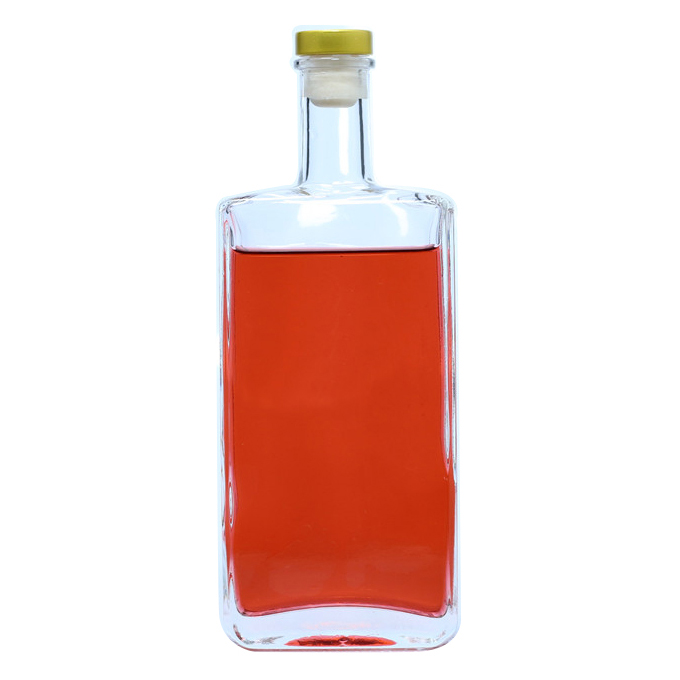
- Label Panel Recess: When applying self-adhesive paper or film labels, engineering a subtle 0.3mm–0.5mm recessed label panel prevents label scuffing when bottles contact each other on conveyor lines and in transit cartons.
- Draft Angles on Rectangular / Square Bottles: Flat-sided whiskey bottles require a minimum draft angle (typically 0.5° to 1.5°) so the glass bottle can be cleanly ejected from the mold halves without leaving suction marks or drag blemishes.
- Embossing & Debossing Limits: Embossed lettering or brand logos on the shoulder or base should generally feature a stroke width ≥ 0.8mm and relief height between 0.4mm and 0.8mm with beveled edges to ensure glass fills the mold cavity crisply without trapping air bubbles.
- Screen Printing & Hot Stamping Surface Requirements: Direct-to-glass silkscreen printing or ceramic decal firing requires smooth cylindrical or flat surfaces free of compound curves. For multi-color printing, specify an orientation notch (indexing lug) on the base or heel so printing machines can register artwork accurately.
Quality Acceptance Standards & Defect Classification
Quality criteria in your purchase agreement must specify standard sampling plans, such as ANSI/ASQ Z1.4 (ISO 2859-1), with clear defect classifications agreed upon in writing before mass production begins:
| Defect Category | Defect Examples | Commercial Baseline Setting |
|---|---|---|
| Critical Defects | Cracks, checks, birdswings (internal glass filaments), sharp glass flash, foreign glass fragments inside the bottle, compromised neck sealing surface. | Acceptance Number = 0 (Zero tolerance; any single critical defect rejects the inspection lot). |
| Major Defects | Out-of-tolerance bore dimensions, severe body ovality, excessive lean (> TIR tolerance), choked bore, gross seed clusters in critical display panels, wall thickness below minimum threshold. | AQL 1.0 – 2.5 (Inspection Level II, Normal Single Sampling). |
| Minor Defects | Small isolated air seeds (< 1.5mm) outside primary visual zones, faint mold seams, minor surface chill marks, light exterior scuffs outside primary label areas. | AQL 2.5 – 4.0 (Inspection Level II, Normal Single Sampling). |
Whiskey Bottle RFQ Checklist for Procurement Teams
When preparing your technical documentation for factory quotation, provide a comprehensive packet containing the following 12 items:
- 1. Dimensioned 2D PDF Drawing: Including nominal capacity, brimful volume, total height, body dimensions, base push-up, finish details, label panel boundaries, and general tolerances.
- 2. 3D CAD Model: In standard STEP (.stp) or IGES (.igs) format for engineering feasibility and mold design simulations.
- 3. Glass Material Grade & Color: Specifying Super Flint / Extra Flint or specific colored glass requirements.
- 4. Target Container Weight: Defined in grams with acceptable mass tolerance range (e.g., 750g ± 25g).
- 5. Neck Finish & Bore Specification: Detailed bore diameters at 3mm and 15mm depths, chamfer angle, and target closure type.
- 6. Closure Matching & Supply Scope: Stating whether closures (corks, caps, capsules) are sourced from the glass manufacturer or third-party suppliers.
- 7. Surface Decoration Specs: Vector artwork, Pantone/color references, silkscreen/decal callouts, frosting, or spray coating boundaries.
- 8. Filling Line Specifications: Maximum line speed (bottles per minute), star-wheel constraints, and wash/rinse temperature conditions.
- 9. Order Quantities & Forecast: Initial production run quantity, annual volume forecast, and requested price breaks (e.g., 10k, 30k, 50k, 100k units).
- 10. Secondary Packaging Specification: Divider cartons, master carton board grade, pallet dimensions (e.g., 1200x1000mm or 48×40 inch), maximum stack height, and pallet wrap style. Refer to available custom bottle packaging options.
- 11. Quality Plan & Pre-Shipment Inspection: Stating required AQL sampling plan, dimensional inspection reports, and certificate of analysis (CoA) requirements.
- 12. Project Timeline & Delivery Terms: Desired sample approval date, target pilot run date, commercial fill date, destination port, and Incoterms (FOB/CIF/DDP).
Ready to Submit Your Whiskey Bottle RFQ?
Having clear technical specifications accelerates factory review and ensures accurate, competitive quotations without unexpected tooling or redesign charges.
Submit your drawings and project specifications directly via our Request a Quote page, or order physical sample containers through our Bottle Samples program to evaluate glass clarity, weight, and finish compatibility firsthand.
Frequently Asked Questions (FAQ)
1. What is the standard glass weight for a 750ml premium whiskey bottle?
Standard commercial 750ml spirits bottles generally weigh between 450g and 550g. Premium craft whiskey bottles and decanters featuring a thick, solid glass base (heavy bottom) typically range from 650g to 850g, with ultra-premium decanters reaching 950g to 1,200g. Heavier bottles enhance luxury perception but increase freight weight and furnace cooling cycle times.
2. How much headspace should a custom whiskey bottle have?
Headspace should typically represent between 3% and 6% of total bottle capacity, and under U.S. TTB regulations (27 CFR 5.203), it must not exceed 8% of total volume after closure for containers of 200ml or more. Proper headspace accommodates liquid expansion during transport in warm conditions without generating excessive hydrostatic pressure that could push out cork stoppers.
3. What cork bore diameter is best for spirits bottles?
The two most common standard bore sizes for 700ml and 750ml spirits bottles are 18.5mm and 21.5mm. An 18.5mm bore uses a standard 19.5mm synthetic or natural cork shank (providing a 1.0mm compression fit), while a 21.5mm bore uses a 22.5mm–23.0mm shank. The choice depends on bottle height, neck proportions, and target pour speed.
4. Why do custom whiskey bottle drawings require an entrance chamfer on the mouth?
An entrance chamfer (a slight 15° to 30° beveled lead-in edge on the inner mouth rim) guides the cork smoothly into the bore during automatic high-speed corking. Without this beveled edge, sharp glass corners can shave fragments off natural or synthetic cork shanks, resulting in cork dust falling into the whiskey.
5. What dimensional tolerance can glass manufacturers reliably achieve?
Soda-lime glass is formed in molten states and cools inside metal molds, so tolerances are broader than machined metals. For a 750ml container, typical commercial tolerances are ±1.5mm to ±2.0mm on total height, ±1.0mm to ±1.5mm on body diameter, ±0.4mm to ±0.5mm on internal bore diameter, and ±20g to ±35g on glass mass. Critical dimensions must be agreed upon in the approved engineering drawing before tooling commences.
Post time: Sep-24-2026